Mallett Surname Origins
Theories regarding the Meaning of the Name
Debbie Kennett, writing in "The Surnames Handbook" 3 suggests that all surnames fall into four main categories:
- "Locative" or "Toponymic", based on a geographic feature (e.g. "Hill") or location (e.g. "Newton");
- "Patronymic", based on given names or pet names (e.g. "Martin");
- Occupational (e.g. Smith); and
- Nicknames — sometimes with an obvious meaning (e.g. "Little"), and otherwise a catch-all for any name whose meaning has been lost and doesn't seem to fit any of the categories.
P.H. Reaney, writing in "A Dictionary of British Surnames" 4 suggests that Mallett might fall into either of two of the above categories, Patronymic or Nickname:
- "Maleit is OFr [Old French], past participle of 'maleïr' ie 'cursed'" [Nickname].
- "The three Domesday Book tenants-in-chief, frequently mentioned and invariably as Malet, may have brought with them a Norman patronymic, adiminutive of Malo, the popular form of the name of St Maclovius, a 6th century Welsh monk who worked in Brittany, which survives in St Malo andin the church of Saint-Maclou in Rouen. Malo, Malet and Maclou survive in France, the latter particularly in Seine-Inférieure, Eure and Calvados." [Patronymic]
- "Tradition claims that the surname of William Malet, founder of Eye Priory, arose 'ob bellicam fortitudinem eo quod in praeliis hostes ut malleo contunderet' [arose 'for his military prowess because in battles he would crush his enemies like a hammer]. This is supported by the form Gulielmo agnomine Mal(l)eto in Orderic and William of Poitiers. …Knight expert in the use of…mace, the mailz de fer of the Chanson de Roland. OFr maillet, mallet, a diminutive of mail, mal (Latin malleus) 'hammer'. cf. OFr mailleor 'hammerer', smith", and V. MARTEL." [Nickname]
- "In England the chief source of the surname is Mal-et, a diminutive of Mall (Mary) [an early example is given; Maleta (Yorkshire 1219)]. Mallet may also be a late development of Mallard." [Patronymic]
Reaney obviously favours number '4' as the main source of Mallett, but the geographic distribution of the name suggests otherwise. While it is clear that not everyone with the Mallett surname is a direct descendant of the early Norman Malets, it still seems likely that the name derives from them. There are many reasons why someone who bears a given surname does not share the genes of the founder of that name; i.e. adoption, illegitimate birth, etc., but that doesn't change the facts surrounding the origins of the name, or that person's connection to it.
Earliest Known Use of the Name in England

The image above is an actual excerpt from the Domesday Book 1, compiled in the year 1086. It gives us the first recorded instance of the Malet surname in England, and it is quite clearly written as "Malet", indicating that Robert Malet held the village of "Wellebrune" (modern day "Wellbourn") in Lincolnshire. There are many more such entries, and the name is always spelled the same way.
English Pronunciation
'Malet' as written in the Domesday Book is obviously very close to the most common modern day spelling in England of 'Mallett', but would the pronunciation be the same for both? In modern English, for the English branches of the family at least, Mallett is pronounced with a short 'a' sound in the first syllable, like 'pal' and a short 'e' sound in the second, like 'pet'. The emphasis is on the first syllable, and the 't's are pronounced at the end.
But how would 'Malet' have been pronounced 1000 years ago? We can't be certain, but a clue lies in the fact that the Domesday Book was undoubtedly written by Clerics, putting the spoken word to paper in "Ecclesiastical Latin" 2. According to those rules of pronunciation the 'a' in the first syllable would have an "uh" sound, like the second 'a' in area, but otherwise it would be the same as modern English: the emphasis would have been on the first syllable, the 'e' in the second syllable would have been short, and the 't' at the end would have been pronounced. Perhaps this accounts for the "Mollett", and "Mullett" variants found in the British Isles today, but even though the pronunciation of the two names is not exactly the same, they are still quite close, and as English pronunciation changed, the pronunciation of Malet would have changed with it.
English Spelling


The second box contains the signature of Oliver Mallett, gathered by the Heralds during their "Visitation of Devon" in 1620. Oliver was the head of the "Mallet of Ash" family located in Iddesleigh, Devon, also descended from the Malets of Enmore. It isn't just the fact that 100 years had passed that accounts for the difference in spelling — the Malets of St Audries seem to have maintained the "Malet" spelling throughout their history, right up to the present day. The Mallets of Ash settled on "Mallet" (dropping the second 't') as their family's version of the name sometime in the late 19th century, and their descendants hold to that spelling today. Up to that point though, they seem to have spelled it as "Mallett" (with two 't's), as Oliver did in 1620.
Many families spun out of the Mallet of Ash line and established themseleves in Devon and Cornwall. Most of them spell the name as 'Mallett', with two 'l's and two 't's, but some use 'Mallet' (two 'l's and one 't'). There are also many "deviant"³ spellings that have been found in the public record, but it must be remembered that these recordings of the name were made by third parties, such as census enumerators, possibly dealing with illiterate "Malletts", and neither party knew how to spell the name for certain. There are many examples of these spellings in the 1851 Census, but they occur in such small numbers that they can't be considered to be true variants³.
Geographic Origins
Surnames were not in general use in England prior to the Norman Conquest of 1066. They were introduced by the Normans, who had only just begun to use them themselves³.
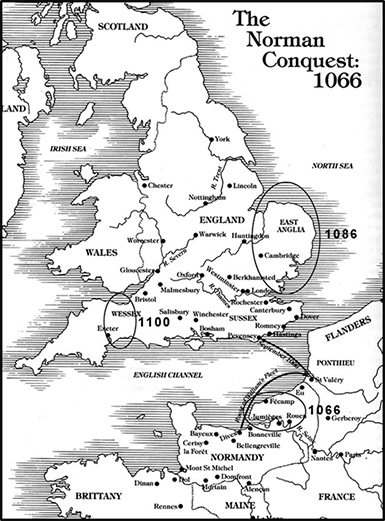
There are several theories regarding who the first Somerset Malets were. The theory favoured here is that Gilbert Malet, a brother of Robert of Suffolk attained the lands through marriage to the daughter of Roger de Courcelles who held them at the time of Domesday in 1086.
In addition to the lands in England described above, the Malets continued to hold their original lands in Normandy after the Conquest, and had a presence in the Channel Islands, located between England and France.
As the above map shows, the Malets were established in 3 major locations by the early part of the 12th century.
Geographic Distribution in Modern Times
There are many bearers of the Mallet(t) surname who today can trace their ancestry back to Normandy, and also to the two areas of England where the Malets established themselves after the Conquest.
This website deals only with the English branches. The geographic distribution of the Mallett (and variants) surname from 1538 to 1851 can be seen in a series of maps identified in the menu to the left.
Sources:
- Powell-Smith, Anna. Open Domesday.
- Martin, Michael, How to Pronounce Latin.
- Kennett, Debbie, The Surnames Handbook (The History Press, 2012).
- Reaney, P.H., A Dictionary of British Surnames (Routledge and Kegan Paul, 1966).
Author:
Bob Mallett
Ottawa, Ontario, Canada
November 30, 2025.