Malet of Curry Mallet, Somerset c.1130
At the time of Domesday in 1086 the Malet family does not appear to have held any land in Somerset, but by the mid 12th century they clearly had come into possession of at least some of the lands held at the time of Domesday by Roger de Courseulles (recorded as "Corcelle" in the Domesday Book); most notably "Sepetone" and "Curi", towns known as "Shepton Mallet" and "Curry Mallet" today.

The first Malet known to hold these lands was Robert, born c. 1094. Robert Malet was followed as Baron of Curry Mallet some time before 1156 by William I (d. 1169), then Gilbert (d. 1194), and finally William II (d. circa 1216). William II Malet was Sheriff of Somerset and Dorset, and one of 25 Surety Barons who were charged with the enforcement of the Magna Carta in 1215.
The Curry Mallet line ended with William II’s death. He left three daughters among whom his estates were divided: Mabel, who married first Nicholas Avenel and then Hugh de Vivonia (d. 1249) of Chewton (Somerset); Helewise, who married first Hugh Pointz (d. 1220), and second Robert de Mucegros (d. 1254), a future servant of Henry III; and Bertha, who died unmarried before 1221. Most of the Malet lands passed to the de Vivonia and Pointz families, with the exception of the lands around Enmore Castle which were separately owned by the descendants of Sir Baldwin Malet, younger son of Robert Malet, the first Baron of Curry Mallet.
Malet Family Accession to the Curry Mallet Estates
As stated above, the first Malet known to hold the Honour of Curry Mallet was Robert Malet, but where does he fit in the larger Malet family known to exist in England at this time?
It is important to state at the outset that we have no historical record explaining exactly who this Robert was; only theories. All of the theories however lead us to conclude that even though we don't know for certain where, when or to whom Robert was born, we have no reason to suspect that he was not in some sense a descendant of the William Malet known to have been one of the Knights who accompanied William the Conqueror in 1066.
It is also important to understand that at this time in English history anyone who held land did so at the pleasure of the King, so the King could, (and did—there are many examples) on the one hand grant lands to anyone he chose to, such as the Honour of Eye or the Honour of Curry, and just as easily take them away and grant them to someone else. Once granted, the lands could be inherited by the next generation of the family holding the grant, but the King could still take the land away if he chose to.
This happened to the Malets at Eye, Suffolk, where the Honour was originally thought to have been held by the first William who, upon his death passed it to his son Robert, who held it in 1086 at the time of the Domesday survey. The honour was taken from Robert (or he willingly gave it up) sometime after the death of King William I, restored to him after 1100, then removed from the Malet family for the final time in 1110 when Robert's son William was banished from England.
The Malets ceased to be major landholders in England after 1110, but they didn't disappear from the historical record in England during the time period during which The honour of Curry came into the possession of the Malet family:
- Ralph and Walter Malet (perhaps the sons of Durand) held lands in Lincolnshire in 1115-16
- A (second?) Ralph Malet was sheriff of Wiltshire in 1154-5
- A Robert Malet occurs with reference to Warminster, Wiltshire during the decade of 1120-30
- A Robert Malet attested charters of Abbot Anselm of Bury St Edmunds c. 1120-1148 and numerous charters of King Stephen, lord of Eye, during the same period
- A Robert Malet was Steward of the royal household in 1136
It seems likely that the three Robert Malets mentioned above were the same person. The fact that Robert attested to some of King Stephen's charters and that he was steward of the Royal household during Stephen's reign demonstrates that he was in the good graces of the King, despite the fact that we know that William Malet, undoubtedly a relative of this Robert, had clearly been out of favour just 10 to 20 years earlier.
We don't know precisely when the Malet's came into possession of the de Courseulle lands, but Roger de Courseulle is thought to have died somehwere during the reign of William Rufus (1087-1100). When he died his lands reverted to the King, and he conferred them upon Hugh de Monfort.
Arthur Malet in his book "Notices of an English Branch of the Malet Family" states: "we learn from the return made by the Abbot of Glastonbury in the 12th year of Henry II, A.D. 1166+ that Robert Malet had possessed in the time of Henry I property which had been held by Roger de Corcelle [Courseulles], and which at the date of this return was accounted for by William Malet."
He goes on to suggest that Gilbert Malet, son of William and brother of Robert of Eye married either the sister or daughter of Roger de Courseulles, and that they had a son Robert who eventually came into his mother's lands. There is no solid evidence for that theory.
Arthur Malet brings Gilbert into the picture because he believed that Robert of Eye had fallen out of favour with Henry I, and that Henry had confiscated all of Robert's lands, so Henry would not likely have given him any land in Somerset — but Keats-Rohan, in "Domesday Book and the Malets" etc. suggests that Robert Malet of Eye was never out of favour with Henry I, that he sided with Henry against his brother Robert Curthose, and that Henry made Robert Malet the "Great Chamberlain of England".
We know that Robert of Eye's son William was deprived of the Honour of Eye by Henry I in 1110, but we don't know the reason. One might assume that the whole family might be banished, but again, Keats-Rohan suggests that Robert of Eye had a second son also called Robert, and that he was the Robert who signed some of King Stephen's charters at Eye in Suffolk after 1110.
Following the above theory, given that Robert the younger clearly had a close relationship with King Stephen, and that Robert the elder had a similarly close relationship with King Henry, it follows that the Honour of Curry could have been granted to Robert Malet the younger by King Stephen, or by King Henry before him.
But either way you look at it, Robert Malet of Curry Mallet, whether the son of Gilbert or Robert, was without much doubt the grandson of William Malet of 1066 fame.
Curry Mallet Parish Church

This crypt, inside the parish church at Curry Mallet in Somerset, is said to contain the remains of William Malet. In 1879 Arthur Malet, along with his brother Octavius had a look inside.
An Altar Tomb at Curry Malet by A. MALET, ESQ.
As the Church of St. James at Curry Malet is about to be restored, the Rev. C. Leigh Pemberton proposes to remove from its present position an altar tomb, which Collinson in his History of Somersetshire thus notices: "In the north aisle is a large tomb in which are deposited the remains of one of the family of Mallet, but the inscriptions are quite illegible. About 60 years since, on opening this tomb, the corpse was found entire, with one of the legs drawn up, which corresponds with the tradition that the person interred herein had a contracted leg."
The tomb is traditionally said to be that of Lord William Malet, and the rector kindly invited Messrs. Arthur and [Octavius] Warre Malet to consult with him previously to his forming any decision as to its removal; they, therefore, met the rector and the churchwardens, Messrs. W. Thwaits and T. C. Walrond, with the builder, Mr. Blackmore, on the 23rd April, 1879. The tomb stands in the first bay of the north aisle, against the first detached pillar; it consists of a chest hollowed out of a solid block of Ham Hill stone, with a slab of the same sort of stone, without any visible trace of inscription or sculpture. One of the corners of the chest is partially chamfered, as if to accommodate something that formerly abutted on it. The slab or lid has one of its corners cut away apparently for a similar purpose: neither of these mutilations is necessary in the present position of the tomb. The middle of the slab at the west end is cut to fit the pillar against which it stands, so that the chest might be placed against it to gain more space about the pulpit and reading desk to which it is rather inconveniently close.
All this seems to lead to the conclusion that the present is not the original position of the tomb. The covering slab, which is 7 ft. 7½ in. by 3 ft. 9 in., was so far moved by Mr. Blackmore and his workmen that the inside could be partially examined. The chest is hollowed out leaving walls of about 3¾ in. in thickness, and in it is a coffin of oak 5 ft. 11½ in. long, 1 ft. 1½ in. wide at the head, 10½ in. wide at the foot, — inside measurements. The sides and ends are in good preservation, the top a good deal broken; the bottom was not examined, the planks are roughly cut, the marks of the saw being still visible. There is a quantity of decayed wood in the chest, some of it considerably thicker than the present coffin; it is possible that this may be the debris of an outside casing of some more perishable wood than oak, or of the original coffin replaced at some removal by the present one.
The bones, which have been previously slightly disturbed, seem to be all in good preservation; the under jaw, in the opinion of those present who had seen many bodies, being remarkably large and powerful, with very good teeth, precluding the idea of any advanced age. The body had been carefully and tightly swathed in linen, a good deal of which still adheres to the bones, especially to the hands; portions of this and of some other substances adhering to the thigh bone were removed for more minute examination, as an opinion had been expressed that the body had been embalmed. No peculiarities or marks which could lead to identification were observed, and the slab was replaced on the chest.
It was the opinion of all who were present that the tomb is not in the position it first occupied, and that it now interferes very inconveniently with the arrangements for seating the congregation; it was therefore deemed that, if another suitable place were proposed, there could be no valid objection to its removal. The Rector of the parish of Curry Malet, Mr. C. Leigh Pemberton, then decided to remove the tomb a few feet only from its present position, and to place it under the east window at the end of the north aisle; sufficient space being left between it and the walls to allow all sides of it to be seen.
William Malet, Baron of Curry Malet, Magna Carta Surety
William, like his predecessors, had been in royal service. He had accompanied Richard the Lionheart on crusade from 1190 and had taken part in the siege of Acre in 1191. He was appointed sheriff of Somerset and Dorset by King John in 1209 and served in that office until 1212. By 1214 he owed the king as much as 2000 marks (about £1333, close to £1,000,000 in 2017). In 1214 he entered into an agreement to serve with the king in Poitou with ten knights and twenty other soldiers in return for the cancellation of his debt. In 1215 he went over to the barons in their rebellion against the King.

Magna Carta, June 15, 1215
The Magna Carta was, and continues to be a very important document. It consists of 63 articles, perhaps the most important being 39 (Due Process) and 40 (Justice). Those two clauses have stood the test of time and form the basis of the system of government enjoyed by those of us living in the free world known as the "Rule of Law". It means simply that the people have certain rights that cannot be usurped or overridden by their government, whatever form that government might take. Not even the King was above the law. As stated above, prior to this the King technically owned all of the land in England, and could do with it as he pleased. The Magna Carta was a radical departure from that system.
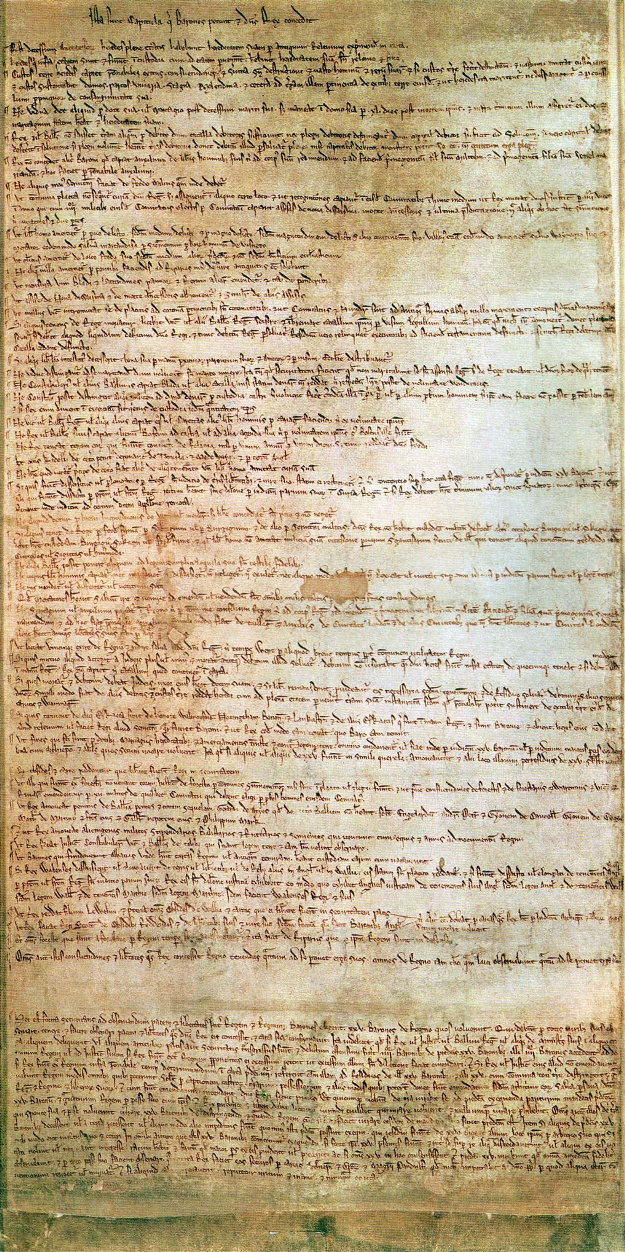
It was agreed to by King John only under duress, because many of his English Barons were in open revolt against his rule, and they forced his hand. King John of course had no intention of abiding by his own charter because it limited what he considered to be his divine right to rule without oversight, and appealed to Pope Innocent III who denounced the agreement and threatened all of the players with excommunication if they actually enacted its provisions.
The Barons saw this coming, and included a provision for enforcement of the agreement in clause 61, a "security clause" establishing a council of 25 barons. Their mandate was to oversee King John's compliance and if he violated the Charter and failed to redress grievances within 40 days, they were empowered to seize his castles, lands, and possessions until he complied.
William Malet, Baron of Curry Malet, was one of the 25.
Many accounts suggest that William was a signatory to Magna Carta. He wasn't, and neither was anyone else. Not even King John signed his name, but he did apply his Great Seal.

The following map shows the extent of King John's dominions, at least as they existed during the reign of his father King Henry II, when they were at their greatest extent. King John, and his brother Richard the Lion Heart before him, did not care much for England; Richard once described it as "cold and always raining". Richard was more interested in Crusading than providing good governance of the lands that he held, and as a result the King of France and other French nobles with their own agendas began to nibble away at the Angevin kingdom created by King Henry II, forcing both Richard and John to constantly engage in battle to retain their lands in France.
Constant military campaigns, whether in the Holy Land or France were very expensive, and both brothers saw England as a 'cash cow' to enable these endeavours. But the levels of taxation and the creative means by which Richard and John sought to raise funds became intolerable to the English Barons, which led to their revolt and to the eventual creation of the Magna Carta at Runnymede.

Baron William Malet died shortly after the events at Runnymede in December of 2015. The Curry Mallet estates then passed to his two daughters and their husbands, therefore no longer in the possession of the Malet family.
King John didn't last much longer. He died about a year later, on October 19, 1216.
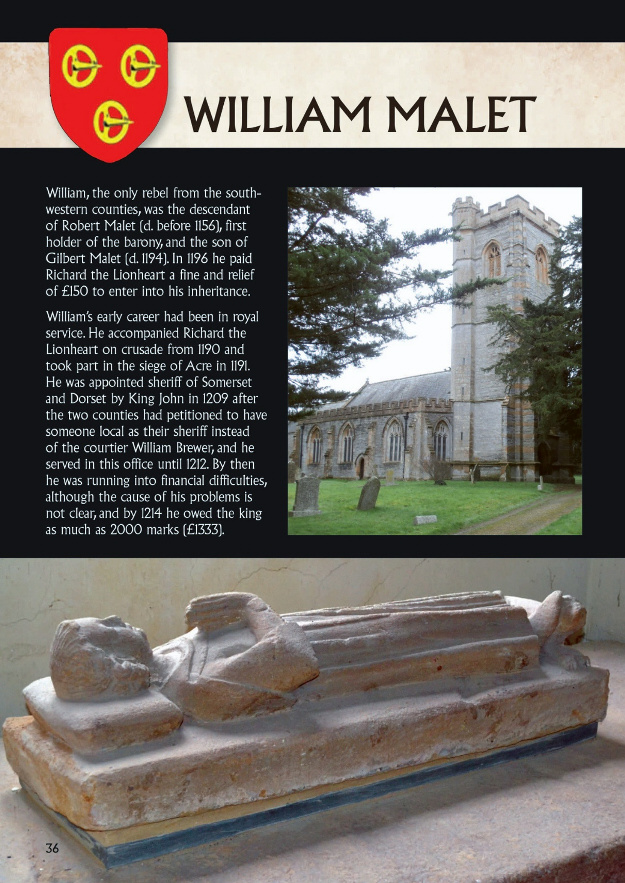
Above Image courtesy Magna Carta Trust/Barons
The Manor House, Curry Mallet

Victorian Drawing of the Manor House by W. W. Wheatley, c. 1850. Somerset County Museum. This building is thought to have been built on the site of the castle occupied by the Malets at Curry Mallet.
Manor House 2016 Front

Manor House 2016 Rear

Shepton Mallet

Shepton Mallet Parish Church

The above effigy of a Norman Knight is one of two in the Parish Church of St Peter and St Paul at Shepton Mallet. They may actually be effigies of Robert and William Malet. They are badly weathered, as they were for many years outside in the graveyard.
Sutton Mallet, 1999

Sources:
- Malet, Arthur, "Notices of an English Branch of the Malet Family" Privately published 1885.
- Hollister, C. Warren, "Henry I and Robert Malet", Monarchy, Magnates and Institutions in the Anglo-Norman World Ch. 7, pp. 129-136.
- Hart, Cyril, "William Malet and his Family", Anglo-Norman Studies XIX pp. 123-165.
- Keats-Rohan, K.S.B. "Domesday Book and the Malets: Patrimony and the Private Histories of Public Lives", Nottingham Medieval Studies 41 [1997] pp. 13-56.
- Magna Carta Trust, Magna carta 800th, The 25 Barons of Magna Carta
- The National Archives (UK), Currency Converter
Author:
Bob Mallett
Ottawa, Ontario, Canada
November 30, 2025.